12 Testaccio Food Facts That Surprise First-Time Visitors
The short answer. Testaccio is named after a rubbish heap, its market is younger than the iPhone, its most famous dishes were invented because the slaughterhouse paid its workers in offal, and two official Roman bodies cannot agree on how tall its hill is. Every fact below carries the body that publishes it.
Rome hands out its famous facts freely. Testaccio's are harder to come by, mostly because they are about work rather than emperors, and several of the ones repeated online turn out to have no source at all. These twelve are the ones that hold up, and each says who publishes it. The best Testaccio food tour below are the walks where a guide will tell you the rest.
1. The quarter is named after broken pots
Testa is a potsherd. Monte Testaccio — Monte dei Cocci, the mound of shards — is an artificial hill built entirely out of broken Roman oil amphorae, and the rione took its name from it. Nothing else in Rome is named after its own rubbish.
2. The Sovrintendenza calls it the first recycling depot in history
The Sovrintendenza Capitolina describes the mound as la prima discarica differenziata nella storia — the first selective waste-disposal site in history. The jars were sorted, broken to a pattern and limed as they were stacked, in courses, over about a century and a half.
3. Two official bodies give two different heights
The Sovrintendenza Capitolina's monument page says 54 metres. A Roma Capitale news page says about 35 metres. Both give the circumference as roughly a kilometre, so they are describing the same hill. Neither reconciles the difference, and the history page prints both rather than choosing.
4. Nobody official has counted the amphorae
A figure of 53 million circulates all over the internet. It appears on no official page. Roma Capitale says only "millions of fragments", and that is as far as this site will go.
5. You cannot climb the mound on a whim
Monte Testaccio is fenced. Visits are by reservation only through 060608, in escorted groups of no more than thirty, at €4 full and €3 reduced, free for residents of Rome, entering at Via Nicola Zabaglia 24. Plenty of guides online suggest otherwise. The Sovrintendenza's own page does not.
6. Under the Aurelian wall there is a pyramid
The Pyramid of Cestius went up between 18 and 12 BC for Gaius Cestius, in 330 days, under the terms of his will — the inscription says so. It is 36.40 metres tall on a base of 29.50 metres a side, and it survives because it was later built into the city wall.
7. Its own ministry lists it as closed
The Ministero della Cultura's page for the pyramid shows it temporarily closed to the public, with reservation mandatory. It opens on scheduled free openings booked through Coopculture, and those go quickly. From the street it costs nothing.
8. Keats, Shelley and Gramsci are all buried here
The Non-Catholic Cemetery on Via Caio Cestio has buried Rome's foreigners since 1716: over six thousand graves, more than fifty denominations, nearly sixty countries. Entry is free with a requested €5 donation. It is four hundred metres from the market.
9. The quarter exists because the port did
From the first century AD this riverbank was the Emporium, Rome's main port, at its height under Trajan: a travertine quay, warehouse rows over a cryptoporticus, offices above. It was abandoned by the fourth century and buried until the nineteenth. Testaccio is flat because a port needs flat ground.
10. The slaughterhouse invented the menu
The Mattatoio was built between 1888 and 1891 to Gioacchino Ersoch's design, across about 25,000 square metres, and it worked until 1975. Its workers were paid partly in the quinto quarto, the fifth quarter left when an animal is divided into four: offal, head, tail, feet. Coda alla vaccinara, trippa and coratella all come from that.
11. Four famous pastas, two ingredients
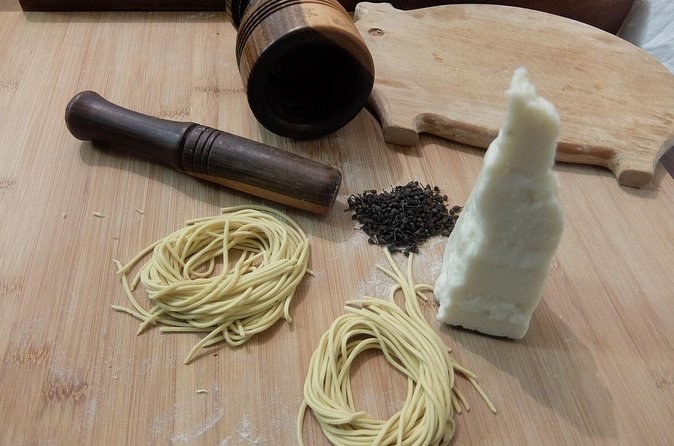
Gricia is guanciale and pecorino. Cacio e pepe swaps the guanciale for pepper. Amatriciana adds tomato to the gricia. Carbonara adds egg. All four rest on pecorino romano and cured pork cheek, both bought at the market, and what to eat in Testaccio takes them one at a time.
12. The market is newer than you think
Mercato Testaccio opened in its current building on 2 July 2012. Before that it traded in the open on Piazza Testaccio. A hundred stalls, four entrances, a Roman warehouse underneath, and hours of 7:00 to 15:30 from Monday to Saturday — the whole of it set out on the market page.
The twelve, at a glance
If you want the sourced version in one place, here it is. Use it to tell a fact from a repetition when you read about the quarter elsewhere.
| The fact | The figure | Who publishes it |
|---|---|---|
| Monte Testaccio's height | 54 m, and about 35 m | Sovrintendenza Capitolina; Roma Capitale |
| Its circumference | About 1 km | Both, and they agree |
| Its volume | About 580,000 m³ over 2 hectares | Roma Capitale |
| When it was built | Mostly 140–250 AD | Roma Capitale |
| Visiting it | €4 / €3, reservation on 060608 | Sovrintendenza Capitolina |
| The pyramid's date | 18–12 BC, built in 330 days | Ministero della Cultura |
| The pyramid's size | 36.40 m tall, 29.50 m a side | Ministero della Cultura |
| The cemetery | Since 1716; 6,000+ graves; €5 donation | The cemetery itself |
| The Mattatoio | Built 1888–91; closed 1975 | Roma Capitale tourism; press for the closure |
| The market building | Opened 2 July 2012; 100 stalls | Architecture press; the market |
| The market's hours | Mon–Sat 7:00–15:30 | The market |
| The amphora count | Not published anywhere official | — |
Why you will read the wrong version elsewhere
Two of these facts get repeated wrongly more often than they get repeated right, and you will meet both. The first is the amphora count, which is quoted with confidence by pages that cannot say where it came from. The second is the idea that you can walk up Monte dei Cocci: several guides say so, and the body that controls the site says the opposite.
If you only remember one thing from this list, make it the phone number. Book 060608 before you travel and the mound becomes the best hour in the quarter; leave it and you will be looking at a fence. That, and the market's closing time, are the two facts that will change what your day looks like.
The ones we left out
Three things you will read elsewhere are not here, on purpose:
- The amphora count. No official source publishes one.
- A ticket price for the Mattatoio. A combined figure circulates on aggregator sites and is not on the venue's own pages.
- Bus route numbers. The transport authority's planner could not be queried, so planning your visit names the metro line and the trams only.
Walks that take in the mound, the pyramid and the market
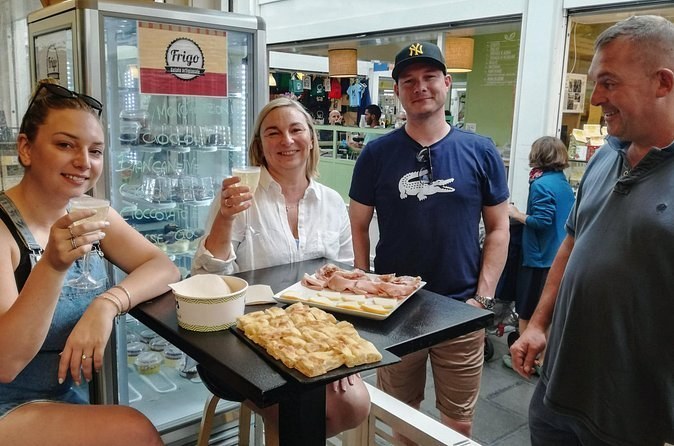
Testaccio Quarter Market and Pyramid Food and Sightseeing Tour
The pyramid, the cemetery, Monte dei Cocci and the market in one loop.
From $373 per person
Check Availability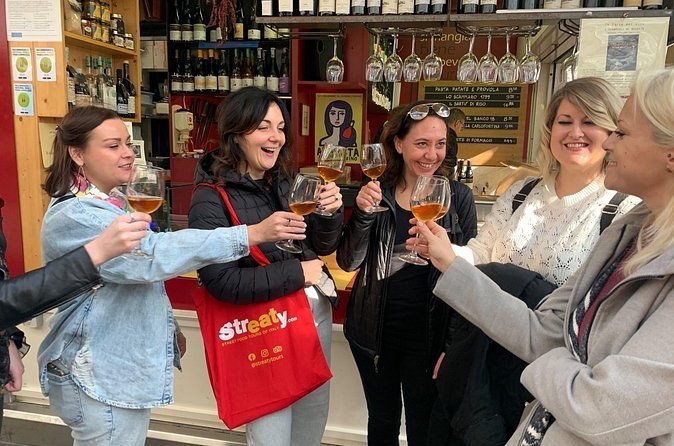
The Original Rome Food & Market Tour (All-Inclusive)
Across Ponte Testaccio for the market, a trattoria lunch and three wines.
From $117 per person
Check Availability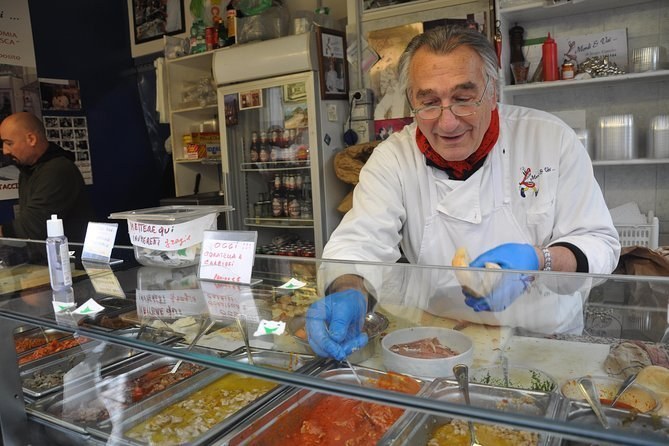
Off the Beaten Path: Semi Private Rome Food and Wine Walking Tour in Testaccio
Testaccio's bakeries, market and wine bars over three and a half hours.
From $97 per person
Check AvailabilityNext: find the walk that takes in the mound and the pyramid as well as the stalls. Every fare sits side by side on Testaccio Food Tours.